TOP Free Proxy List


Free vs Paid Proxies: Which One Should You Choose?
Published 20/08/2026 · Updated 11/10/2026
"Free vs paid" comes up constantly when people are choosing a proxy, and the honest answer is that neither one is universally better — they're suited to different situations depending on volume, reliability needs, and how much setup time you're willing to spend. This article breaks down what actually differs between them technically, what it really costs (in money and in time) to use each, and gives a practical guide to which one fits a given task.
How free proxies work
Free proxy lists, including this one, aggregate publicly available proxy servers from various sources. Nobody is paying to maintain these servers specifically for you — they're often personal servers, misconfigured infrastructure, or intentionally shared community resources. Because there's no service agreement behind them, availability is inherently unpredictable: a proxy that works now can go offline, get overloaded by other users, or disappear entirely within the hour.
To manage that unpredictability, a good free proxy list refreshes constantly (this one syncs every 15 minutes) and shows live metrics — uptime and response time — so you can prioritize the more reliable entries rather than picking blind. The tradeoff is time: you're spending a small amount of effort filtering and verifying in exchange for paying nothing.
How paid proxies work
Paid proxy services sell dedicated or semi-dedicated access to proxy infrastructure they operate and maintain themselves. Because there's a service relationship (and usually a service-level agreement), you get consistent uptime, predictable speed, and often additional features like automatic IP rotation, session persistence, or geographic targeting down to the city level. That reliability is the entire value proposition — you're paying to remove the unpredictability that comes with free options, and to remove the ongoing time cost of finding and re-verifying working proxies yourself.
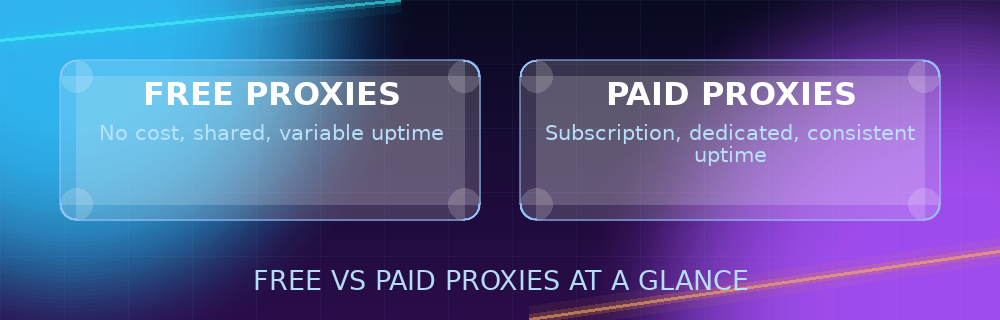
Free vs paid: the key differences
- Cost: Free proxies cost nothing; paid proxies are typically billed monthly or by bandwidth/request volume, and prices scale with how much traffic and how many IPs you need.
- Reliability: Free proxies vary constantly and require checking before use; paid proxies come with an uptime guarantee backed by the provider's own infrastructure.
- Speed: Free proxies are shared and can be slow or congested; paid proxies usually offer dedicated or lightly-shared bandwidth with more consistent response times.
- Scale: Free lists are fine for occasional or small-scale use; paid services are built for sustained, high-volume, or business-critical use.
- Support: Free proxies come with no support of any kind — if one stops working, you simply move to another; paid services typically offer customer support, documentation, and sometimes account management.
- Trust and origin: With free proxies, you generally don't know who operates the server; paid providers are identifiable businesses with reputations and terms of service to uphold.
The real cost of "free"
It's worth being honest that free proxies aren't entirely costless — the cost just shows up as your own time instead of money. Finding a currently-working proxy, verifying it, and swapping it out when it dies takes a few minutes here and there. For occasional use, that time cost is trivial. For continuous or large-scale use, it adds up fast and can end up costing more in effort than a modest paid plan would have cost in dollars. The right comparison isn't "free vs. costs money," it's "pay with a small amount of your time vs. pay with a subscription" — and which one wins depends entirely on how much volume and reliability the task actually needs, and how much your own time is worth relative to a subscription fee.
When free proxies make sense
Free proxies are a genuinely good fit for occasional, low-stakes, or exploratory tasks:
- Checking how a page looks from another country a handful of times.
- Testing whether your own scraper or automation logic works correctly before deciding whether to scale it up.
- Casual browsing or one-off anonymity needs.
- Learning or experimenting with proxy configuration itself, without wanting to commit to a subscription first.
- Any task where the volume is low enough that paying for dedicated infrastructure wouldn't make economic sense in the first place.
- Personal projects, hobby scripts, and side projects where the goal is learning or getting something working rather than running a dependable production service.
When to consider paid proxies
Paid proxies earn their cost back once reliability actually matters:
- Running a scraper continuously in production, where downtime has a real cost.
- Anything customer-facing or business-critical, where an unreliable proxy could break a live feature.
- High request volumes, where constantly hunting for working free proxies becomes its own significant time cost.
- Tasks that need guarantees a free source structurally can't provide — a consistent dedicated IP, guaranteed bandwidth, or formal support.
- Compliance or business contexts where you need to know exactly who operates the infrastructure you're routing traffic through.
If downtime or inconsistency has a real cost attached to it, that's the clearest signal to move to a paid option. It's rarely an immediate jump from zero to a large plan, either — most people who outgrow free proxies start with the smallest paid tier that covers their actual volume and scale up only if usage grows further, rather than over-committing upfront to a plan sized for hypothetical future needs.
What paid proxies typically cost
Pricing varies widely by provider and by what you're buying — a handful of dedicated IPs, a rotating pool, or bandwidth-based access — but a few general patterns hold across the market. Entry-level plans with a small number of dedicated proxies are usually priced for individual developers or small projects. Mid-tier plans with rotating IP pools and higher bandwidth allowances target businesses running regular scraping or automation. Enterprise-tier plans with large IP pools, dedicated support, and custom terms are priced for continuous, high-volume, business-critical use. The exact numbers change often enough that quoting specific figures here would go stale quickly — the point is that cost scales roughly with volume and reliability guarantees, so it's worth sizing a plan to your actual usage rather than defaulting to the largest option.
A simple decision checklist
If you're still unsure which way to go, work through these questions in order:
- Is this a one-off or occasional task? If yes, free is almost certainly enough — go to the proxy list and filter to what you need.
- Would downtime or a failed request actually cost you something (money, a missed deadline, a broken feature users see)? If yes, that's a strong signal to consider paid.
- Are you spending more time hunting for and re-verifying free proxies than the task itself is worth? If yes, the time cost has likely exceeded what a modest paid plan would cost.
- Does the task need a guarantee free sources can't offer — a specific dedicated IP, guaranteed bandwidth, formal support, or verified operator identity? If yes, paid is the only option that actually satisfies the requirement.
- If none of the above apply, stick with free and revisit the decision if your usage grows.
Most people evaluating this question fall into the first case — occasional, exploratory, or small-scale use — where free proxies, used well, are genuinely sufficient rather than just a compromise. It's also worth remembering that the two options aren't mutually exclusive: plenty of people use free proxies for exploratory or low-stakes work and switch to a paid provider only for the specific tasks that actually need the extra reliability, rather than treating it as an all-or-nothing choice.
Common myths about free proxies
A couple of misconceptions are worth clearing up. First, "free" doesn't automatically mean "insecure" — a free proxy carries the same category of risk as any proxy whose operator you don't know, paid or free, if it happens to be poorly run; the real safeguard is avoiding sensitive traffic (logins, payments) over any unverified proxy, not price. Second, "free" doesn't mean "always slow" — plenty of free proxies have perfectly good response times, which is exactly why this list shows live uptime and speed data rather than asking you to guess. Third, "paid" doesn't automatically mean "unlimited" — most paid plans still have bandwidth, request, or IP-count caps, they're just set at a level suited to production use rather than the essentially-unlimited-but-unreliable nature of a free public list.
Getting the most out of free proxies
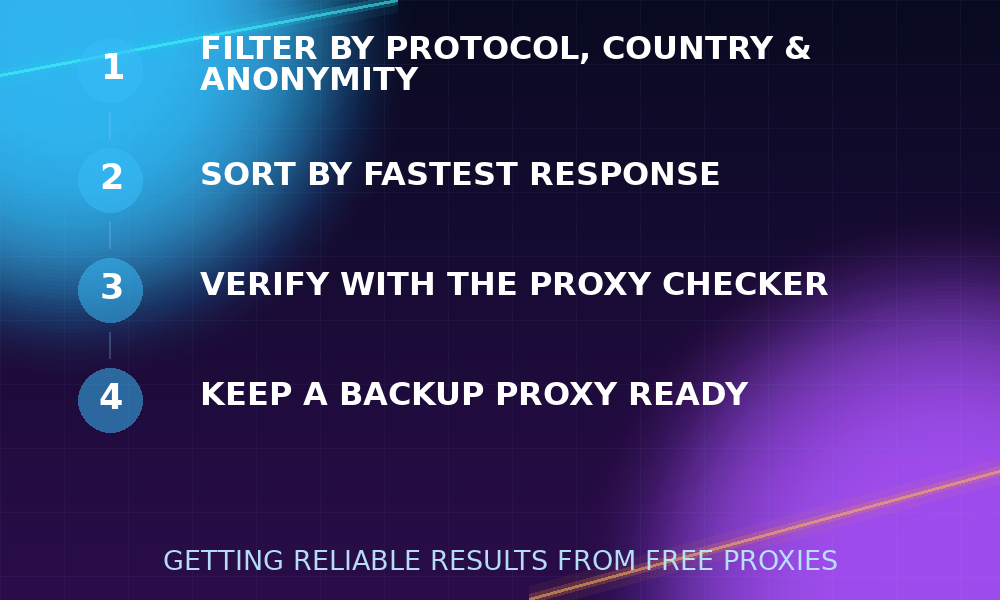
Whichever way you lean, free proxies perform noticeably better when used deliberately rather than by grabbing the first entry on a list:
- Filter before you pick. Narrow the proxy list to the protocol, country, and minimum anonymity level your task actually needs — a smaller, relevant pool beats scrolling a huge unfiltered one.
- Sort by fastest response. This automatically prioritizes proxies with healthy (green/amber) uptime ahead of unreliable ones, so the top results are usually your best bet.
- Verify before you rely on it. Run your candidate through the Proxy Checker to confirm it's actually alive right now, not just recently.
- Keep a backup. Since any individual free proxy can drop at any time, have a second one ready to swap in rather than troubleshooting mid-task.
Neither free nor paid is the "right" answer in the abstract — it depends entirely on how much reliability a given task actually needs, and free proxies, used well, cover a lot more ground than they get credit for.